

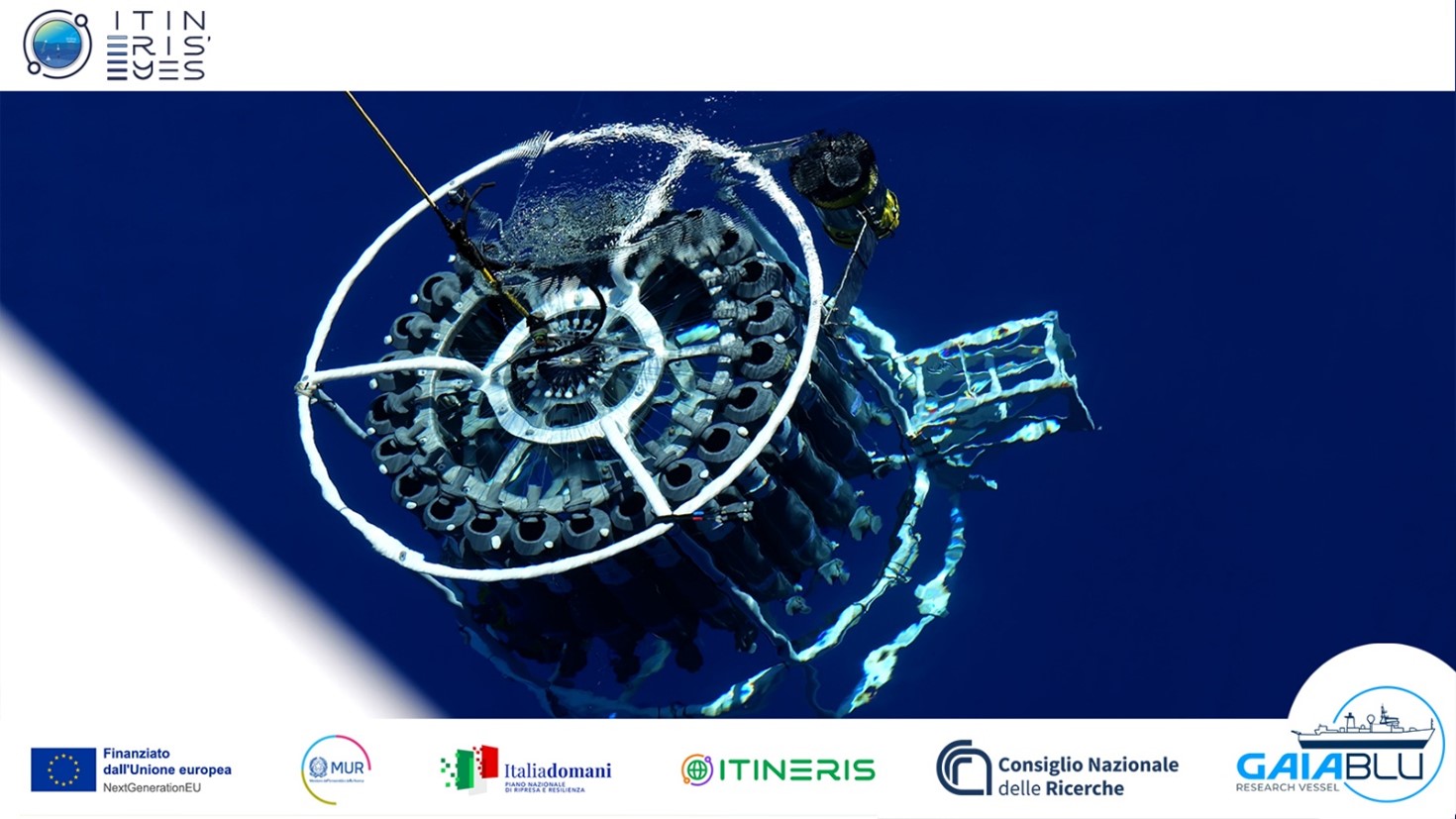
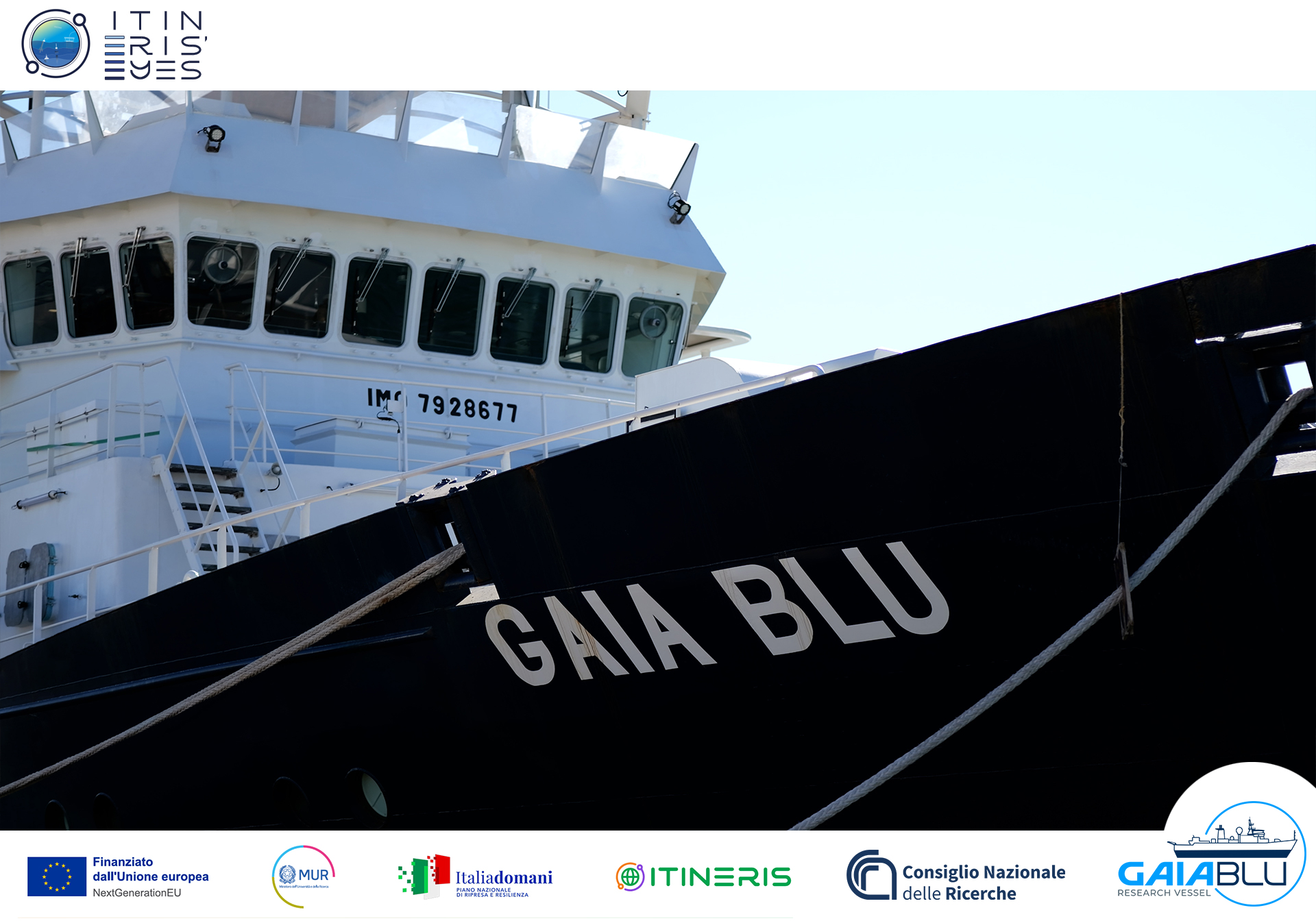
In July 2025, the National Research Council of Italy (CNR) research vessel Gaia Blu set sail from the port of Civitavecchia to carry out ITINERIS’ EYES, an interdisciplinary oceanographic campaign focused on understanding the health and future of Mediterranean planktonic ecosystems. Coordinated by the Institute of Marine Sciences (ISMAR) of CNR within the framework of the ITINERIS project, funded by the National Recovery and Resilience Plan of Italy (PNRR), the campaign offers a tangible example of how integrated research infrastructures can be mobilised to address complex marine and climate challenges. As an active member of EurOcean, CNR contributes to strengthening collaboration, visibility, and coherence across European marine research networks, illustrating the type of collective engagement that underpins initiatives like ITINERIS.
Running from 8 to 30 July 2025, ITINERIS’ EYES brought together scientists, engineers and early-career researchers from Italy, France and Spain to study the effects of climate change on plankton biodiversity, food-web dynamics and the marine carbon cycle in the Mediterranean Sea.
Watching the Mediterranean as a Living System
Plankton form the foundation of marine ecosystems, playing a central role in ocean productivity, biodiversity and climate regulation. Yet Mediterranean planktonic ecosystems are under increasing pressure from warming waters, changing circulation patterns and human activities. ITINERIS’ EYES was designed to observe these systems as a whole, combining physical, chemical and biological measurements to better understand how plankton communities function, respond and adapt to environmental change.
The campaign adopted a multi-platform and multi-disciplinary approach, integrating ship-based observations with autonomous instruments, satellite data and numerical models. Measurements collected during the cruise include key ocean, climate and biodiversity Essential Variables, helping to fill critical gaps in observations, particularly in areas that are otherwise poorly monitored.
Integrating Research Infrastructures at Sea
A defining feature of ITINERIS’ EYES was its strong focus on infrastructure integration. The campaign brought together technologies and expertise from eleven European and national Research Infrastructures operating across the marine, atmospheric and biodiversity domains, including EURO-ARGO, EMSO, ICOS, ACTRIS, DANUBIUS, EUROFLEETS, JERICO, eLTER, DiSSCo, SIOS and LNS.
By testing the interoperability of sensors, platforms and data streams in real operational conditions, ITINERIS’ EYES goes beyond data collection alone and continues through data integration, analysis and dissemination. The resulting datasets are being integrated and made FAIR, contributing to improved marine ecosystem assessments and to the development of the Italian Integrated Ocean Observing System.
Advancing Predictability and Capacity Building
One of the central aims of ITINERIS’ EYES is to improve the predictability of marine ecosystems in four dimensions, from the ocean surface to the deep sea and across time. During the campaign, around 80 autonomous Argo floats and Lagrangian drifters were deployed, extending observation capabilities well beyond the duration and spatial limits of the ship-based activities.
At the same time, the mission places strong emphasis on capacity building. Of the 31 scientific and technical staff involved, a majority were early-career researchers recruited through ITINERIS. Working side by side with experienced scientists, they gained hands-on experience with advanced observing technologies, data integration and interdisciplinary collaboration, strengthening skills that are essential for the future of European ocean science.
From Science to Society
ITINERIS’ EYES also places strong emphasis on sharing science beyond the research community. Throughout the campaign, activities on board Gaia Blu were communicated through a dedicated logbook published on the CNR portal, offering daily insights, images and stories from the ship. The campaign’s visibility was further enhanced through media coverage, including a live television interview highlighting its objectives and early outcomes.
By making complex research activities accessible and visible, ITINERIS’ EYES contributes to greater public awareness of ocean health and the role of science in understanding and protecting marine ecosystems. This approach closely aligns with EurOcean’s commitment to connecting science, policy and society through open and engaging communication.
Opportunities for the EurOcean Network
For the EurOcean community, ITINERIS’ EYES illustrates how integrated research infrastructures can be activated through concrete scientific missions that deliver both knowledge and collaboration. The campaign demonstrates the value of coordinated observations, shared technologies and cross-border teamwork in addressing pressing environmental questions.
More than an oceanographic campaign, ITINERIS’ EYES acts as a bridge between research infrastructures, scientific disciplines and societal needs. By combining advanced observation systems, capacity building and science communication, it embodies the principles of integration, excellence and cooperation that lie at the heart of EurOcean’s mission and vision for European ocean science.