

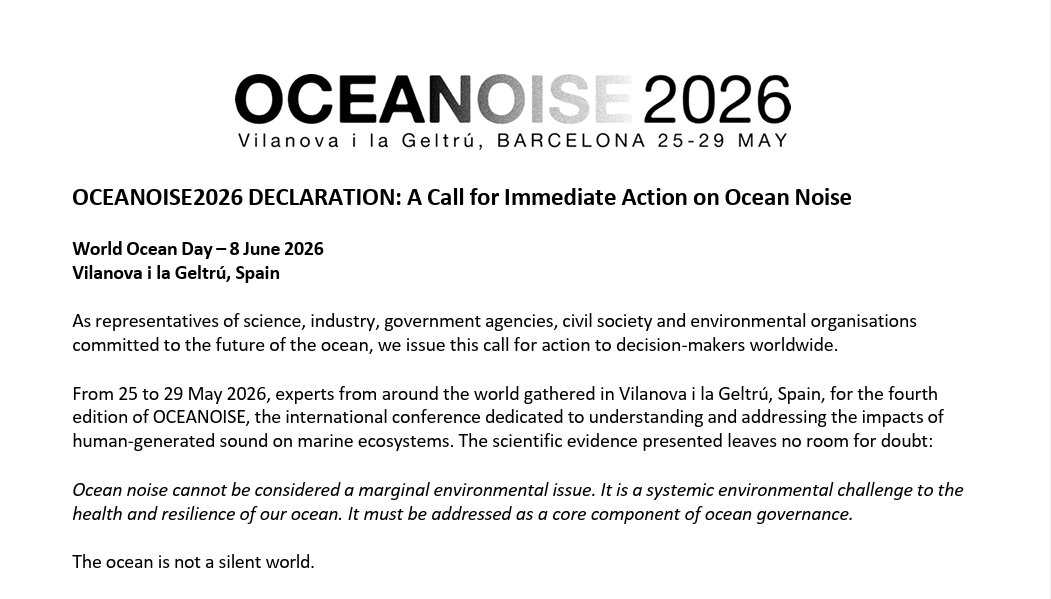
On World Oceans Day (8 June 2026), the Scientific Advisory Committee of OCEANOISE 2026 released a declaration calling for stronger action to address the growing challenge of human-generated underwater noise in the world's oceans.
The declaration follows the fourth edition of the OCEANOISE Conference Series, held from 25 to 29 May 2026 in Vilanova i la Geltrú, Spain. The event brought together experts from science, industry, government agencies, civil society and environmental organisations to discuss the latest developments in underwater acoustics, marine ecology, policy and mitigation measures.
According to the declaration, scientific evidence increasingly demonstrates that underwater noise affects a broad range of marine organisms, including fish, invertebrates and plankton, with potential consequences that extend throughout marine food webs and ecosystems. The signatories argue that ocean noise should no longer be treated as a marginal environmental issue, but recognised as a systemic challenge to ocean health, biodiversity and ecosystem resilience.
The declaration highlights the fundamental role of sound in marine ecosystems. Many marine species rely on sound to communicate, navigate, locate food, avoid predators and maintain ecological connections. As a result, changes to the ocean soundscape can affect both individual species and wider ecosystem functioning.
At the same time, the declaration notes that a new generation of ocean industries and technologies is emerging, including offshore renewable energy, autonomous underwater vehicles, large-scale sensor networks, acoustic communication systems and other digital ocean infrastructures. These developments underline the need for proactive approaches to acoustic management and governance.
To address these challenges, the declaration calls for four key actions:
- Making acoustic impact assessments a standard component of marine planning, environmental impact assessments and technology development;
- Applying the precautionary principle to emerging ocean technologies and industrial activities;
- Considering the effects of sound and vibration across entire marine ecosystems rather than focusing solely on individual species;
- Recognising sound as a fundamental component of Ocean Health.
A central message of the declaration is that ocean noise differs from many other forms of pollution because its impacts can often be reduced immediately when noise sources are modified, mitigated or removed. The signatories therefore emphasise that solutions already exist and that action can deliver measurable benefits in relatively short timeframes.
The OCEANOISE Conference Series has become an important international forum for advancing knowledge on ocean noise, bringing together experts working on noise measurement, modelling, mapping, environmental impacts, regulation and mitigation. Its overarching objective is to support the development of scientific knowledge and practical solutions for a more acoustically sustainable ocean.
The full OCEANOISE 2026 Declaration, entitled "A Call for Immediate Action on Ocean Noise", was released on 8 June 2026 in recognition of World Ocean Day.
For more information and to read the full declaration visit: https://2026.oceanoise.com