

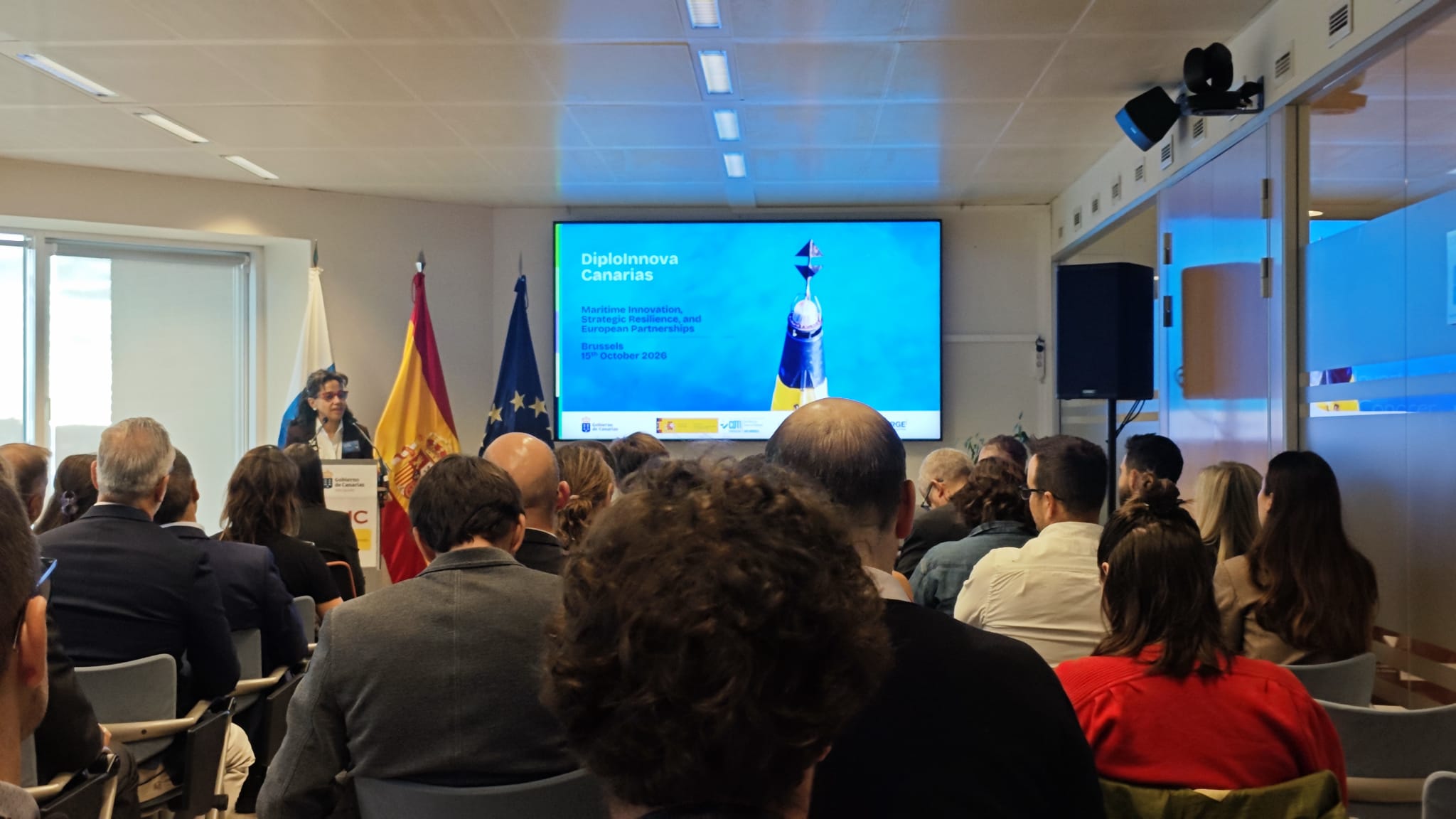
Connecting Europe’s Maritime Strengths: From Capability to Impact
EurOcean’s participation in DiploInnova Canarias in Brussels highlighted a shared European challenge: connecting scientific expertise, research infrastructures, regional priorities and innovation so that marine knowledge leads to practical benefits.
Europe’s maritime future will depend on more than the excellence of its individual research infrastructures, technologies and institutions. It will also depend on how effectively they work together—and how readily their capabilities can be used by policymakers, businesses and communities.
This was a recurring theme at DiploInnova Canarias: Maritime Innovation, Strategic Resilience and European Partnerships, held in Brussels on 15 October 2026. EurOcean joined organisations from across the marine research, innovation and policy communities to explore the capabilities Europe needs and the partnerships that can help deliver them.
The discussions offer a practical perspective on the ambitions of the European Ocean Pact, which brings ocean protection, a sustainable and competitive blue economy, coastal and island communities, research and innovation, maritime security and international cooperation into a common framework. Turning that framework into results requires connections between these priorities, as well as between the organisations responsible for advancing them.
From more data to actionable knowledge
“We don't want to just have more data,” said Delilah Al Khudhairy of the European Commission’s Directorate-General for Maritime Affairs and Fisheries, capturing one of the central messages of the opening discussion.
Europe, she explained, starts from a strong position. Its ocean observation infrastructures, knowledge services, scientific expertise and technological capabilities provide substantial foundations. The challenge is to bring those strengths together into a coherent maritime system.
Her emphasis was on the full connection between infrastructure, observation, data services and actionable knowledge:
“What we want to do is we want to have a European capability, a European system that can translate that data into better maritime situational awareness and better actionable knowledge.”
Interoperability, reliable and secure data flows, and cooperation between research, innovation and industry were identified as essential to that ambition. The objective extends across environmental protection, maritime operations, security and economic activity.
This emphasis is reflected in OceanEye, the European Commission’s initiative to strengthen ocean observation. Its actions include a European digital ocean system offering a single entry point for ocean data and marine knowledge, alongside the development of an operational European Digital Twin Ocean. The policy direction is towards a more connected system in which observations can support understanding and action.
For the marine community, this raises a question that should accompany every investment in knowledge: who needs the results, and what will enable them to use those results effectively?
Accessibility is part of impact
The discussion of EMODnet brought the integration challenge down to the level of everyday use. A service’s value depends not only on the quality of the information it holds, but also on whether users can find it, access it and work with it.
EMODnet’s unified portal provides a concrete example. By bringing its thematic services into a single access point, it simplifies the discovery, visualisation and download of marine data across different disciplines. This demonstrates how coordination between existing services can improve the experience of researchers, public authorities, businesses and other users.
The broader lesson is that accessibility should be considered from the outset. Common formats, interoperable services and a clear understanding of user needs are part of the work required to turn scientific capability into practical value.
That principle applies equally to physical infrastructure. A testing facility or observatory can offer exceptional capabilities, but potential users still need to understand what it provides, how to access it and which expertise can support their work.
The European Strategy on Research and Technology Infrastructures recognises this connection. It seeks to make Europe’s facilities more accessible and better aligned with the needs of scientists, innovators and industry, supporting the journey from scientific research to technological validation and deployment.
Technology needs the conditions to succeed
Another important theme was the distance between developing a technology and putting it into use.
The capabilities-to-action discussion highlighted regulation, investment and spatial planning as necessary conditions for deployment. Technical excellence is indispensable, but it does not resolve every obstacle facing an organisation seeking to test, adopt or scale a solution.
For future partnerships, the implication is practical: these barriers should be considered early. A project needs to understand not only what it intends to develop, but also the conditions under which the result could be used—and who must be involved to make that possible.
This calls for collaboration that extends beyond the research and technology partners alone. Public authorities, infrastructure operators, investors and potential users each bring knowledge that can influence whether a promising result becomes a workable solution.
Regions and SMEs must be able to participate
The regional and business perspectives added an equally important dimension: European cooperation must be accessible to organisations with different priorities, resources and capacities.
The CPMR contribution emphasised stronger regional involvement in Atlantic cooperation, connecting maritime priorities with a broader cross-sectoral perspective. The purpose of cooperation frameworks, in this view, is to generate alliances and joint projects that respond to territorial needs.
The Canary Islands Maritime Cluster highlighted the circumstances of small and medium-sized enterprises. A company may be highly innovative without having the resources or interest to develop and manage European projects independently.
Its contribution argued for participation routes that recognise those differences, including stronger use of cascade funding through organisations able to channel support to smaller businesses. Companies can also contribute as specialised suppliers, technology providers or users of research infrastructure.
The distinction matters: limited participation in European funding should not automatically be interpreted as limited innovation. Effective partnerships should make room for different contributions rather than expect every organisation to assume the same role.
A clear direction for EurOcean
For EurOcean, these discussions reinforce the relevance of OCEAN-30, its strategy centred on improving access to marine information, strengthening collaboration and supporting the use of knowledge across research, policy, innovation and society.
The opportunity is to help make connections that serve a defined purpose: enabling users to discover relevant capabilities, bringing complementary organisations together, and linking scientific expertise with questions that decision-makers need to address.
A science-to-policy approach is particularly relevant here. It begins with understanding the decision, identifying the evidence required and bringing the appropriate expertise into the conversation. Communication remains important, but it is most useful when it forms part of that relationship from the beginning.
The Brussels discussions point towards a demanding but practical measure of progress. Europe’s maritime strength should be judged not only by the infrastructures it builds, the data it collects or the projects it funds, but also by what those investments enable people and organisations to do.
For EurOcean, the task is to help turn Europe’s existing strengths into shared capacity—and shared capacity into knowledge that can be used.